Insaaf Transport · Case study · 4 min read
Insaaf Transport
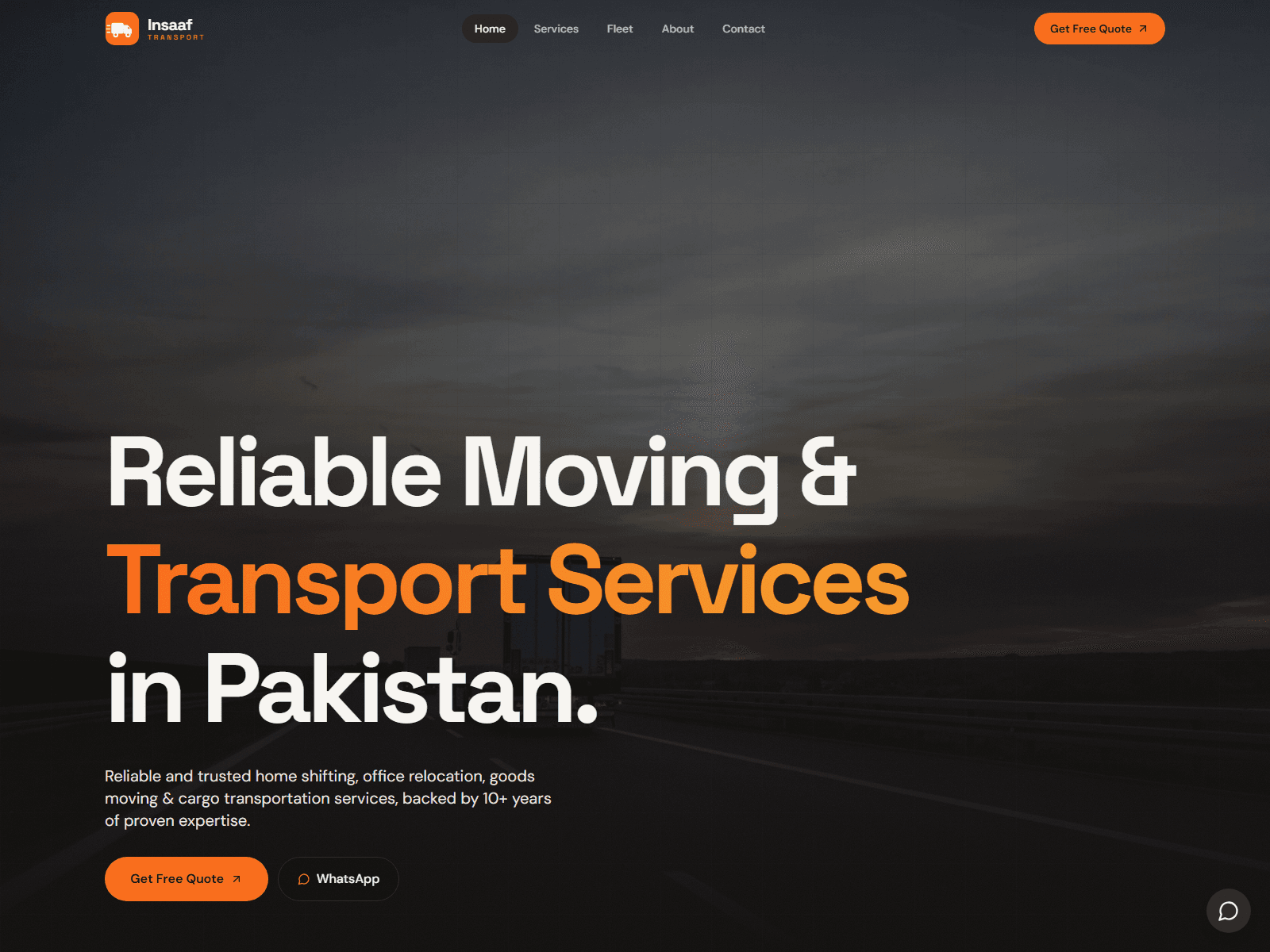
A moving company that needed a website that sells trust in four seconds and turns every visitor into a WhatsApp quote.
Insaaf Transport is a live client project. The site is running and taking real bookings today.
- Client
- Insaaf Transport
- Year
- 2025
- Role
- Full-stack developer & designer
- Duration
- 5 Weeks
- Industry
- Logistics, Moving services
- Tools
- React, Vite, TypeScript, Tailwind, Framer Motion
- Web design
- Front-end development
- SEO landing pages
At a glance
Challenge
A moving company is judged on one thing: can a stranger trust them with their furniture, their address and their money. Insaaf had quotes arriving only by phone referral, a fleet of real trucks with no digital presence, and no way to rank for the searches that actually convert — “moving company in Lahore”, “house shifting charges”. They needed a website that could carry the credibility of a national brand while still feeling local and personal.
Solution
A React and Tailwind marketing site built around service-led city pages, each with its own pricing, coverage list and quote path, so every search term lands on a page written for it. The fleet gallery is draggable, letting people walk the trucks before they call, and every quote form, phone number and floating button hands off to WhatsApp with the service and city already filled in.
Outcome
The site is live and converting. Every quote starts in WhatsApp, the city pages cover the routes the business actually runs, and the whole thing ships as static assets on a CDN so it stays fast and cheap to host.
Deliverables
- Service and city landing page system
- Draggable fleet gallery
- WhatsApp quote hand-off flow
- Responsive design system
- On-page SEO foundation
Overview
Insaaf Transport moves households and offices across Pakistan. The brief was not “make a website” — it was “make the phone ring”. Every design decision was judged against a single metric: does this bring a real, priced, moving quote into the WhatsApp thread.
I designed and built the site end to end: information architecture, page templates for each service and city, the visual language, and the front-end that ships it.
The challenge
Local logistics is a trust business dressed as a price business. Customers compare two things — the quoted price and the evidence that the operator is real — and they check the second one by looking for photos of the actual trucks.
Most competitor sites lose the customer in the first ten seconds: a carousel of stock images, a phone number in the header, and a form that asks for everything before giving anything.
- Rank for city + service searches that carry real intent
- Show the real fleet, not stock photography
- Cut the quote flow down to a single WhatsApp message
- Work on a phone first — most enquiries come from mobile data
- Stay fast and cheap to host for a small operation
Approach
1. One page per city, written like a local
Instead of a single service page, the site ships a landing page for every city the business runs routes to. Each one names real neighbourhoods, real distances and the real price band, which is what a customer is actually searching for when they type “shifting from DHA to Gulberg”.
2. Let the fleet do the selling
The gallery is a draggable strip of the actual trucks and equipment, with the model, capacity and service type on each card. Dragging a truck is a small, tactile moment that makes a stranger look twice, and the second look is where trust starts.
3. Never make the customer fill a form
Every action — the header button, the floating WhatsApp chip, each service card, each city block — opens WhatsApp with the service and location pre-written. The customer can read and send it in one tap, which is why the conversion survives on mobile.
The solution
A React single-page application with a static build, deployed to the edge. Tailwind carries the design tokens so every city page inherits the same spacing, type and colour rules. Framer Motion handles the gallery drag, the section reveals and the card transitions — motion is used to direct attention, never to decorate.
The result is a site that loads in a fraction of a second on a mid-range Android, works on a poor connection, and hands every interested visitor straight into a conversation.
Results
Insaaf Transport is running on this site today. Quotes arrive by WhatsApp with the service and city already set, the fleet gallery is the most-clicked element on the page, and the city landing pages are the entry point for the majority of enquiries.
Key takeaways
For a local service business, the fastest win is usually not a redesign — it is removing every step between “I need this” and “I am talking to someone about it”.
City and service landing pages are the cheapest long-tail SEO available to a local business, and they only work if each one is genuinely written for that route rather than a copy-paste of the homepage.
We used to wait for the phone to ring. Now the quotes come in while the customer is still standing in their kitchen with the boxes stacked. The site does the selling before we even pick up the phone.
FAQ
What does Insaaf Transport handle?
Home shifting, office relocation, cargo transport, packing and loading, and truck rental — across the cities listed on the site, with the coverage and price band spelled out per route.
How do I get a quote?
Every service and city block on the site opens WhatsApp with the details already written out. Send the message, send photos of the load, and the quote comes back in the same thread.
Is the site available offline or on slow connections?
It is a static build served from the edge, so the pages stay fast and readable even on a weak mobile connection, which matters more than any effect on the page.
Have a project in mind?
I design and build production websites, platforms and documentation — from the first wireframe to a live deployment.
Master Cut Barber
Explore case study